
Most golf shots spend much of their journey away from the ground. A putt does not. After the brief launch and skid that follow impact, the ball settles into a roll and remains in contact with the playing surface almost all the way to the cup.
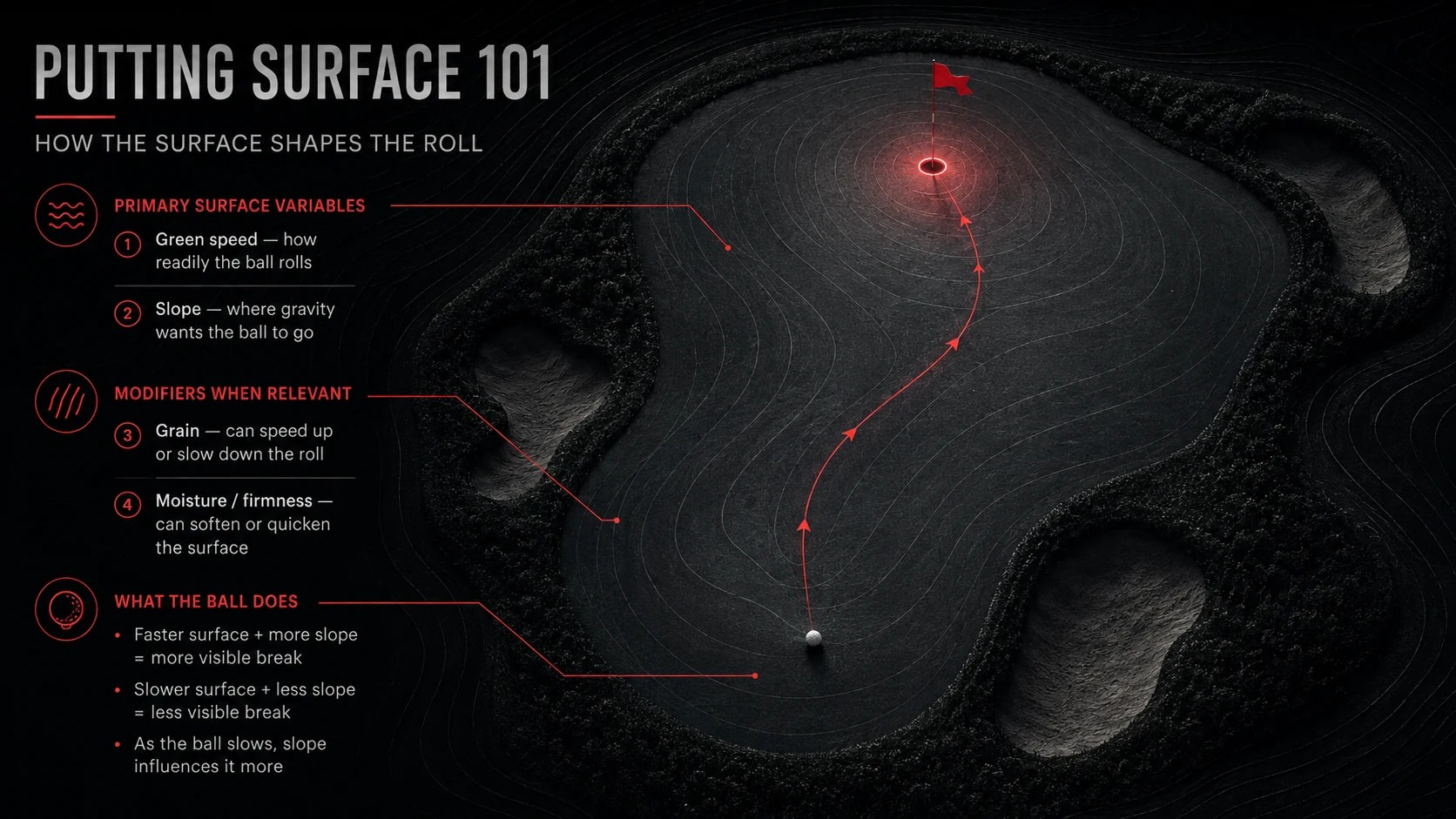
That makes putting different. The putter starts the ball, but the green shapes what happens next. Its speed influences how much energy the putt requires. Its slope gives gravity a direction. Grain, moisture, firmness, and smoothness can modify the roll. Once the ball is moving, all of those conditions continue working on it.
The green is part of the putt. Read the surface before you step in. Then choose pace and line together, picture how you want the ball to arrive at the cup, and carry one clear intention into the stroke.
THE KEY TAKEAWAY
The green is part of every putt. Read the surface first, choose pace and line together, and picture how you want the ball to enter the cup.
Understand the Surface First
Start with green speed and slope. They are the two foundational surface variables because they matter on virtually every putt. Green speed describes how readily the surface allows the ball to roll. Slope describes where gravity wants the ball to go.
For the same distance and slope, a faster surface generally requires less initial energy and allows the ball to respond more visibly to the slope. A slower surface requires more energy and often produces less visible break. The relationship becomes especially clear near the hole. As the ball loses speed, gravity has more opportunity to pull it toward the low side.
Grain and surface condition matter too, but they refine the read rather than lead it. Grain can add or subtract pace on some grasses. Moisture, firmness, smoothness, traffic, and growth can change friction. Their importance varies by course, weather, maintenance, and time of day, so observe the green you have rather than assume it will match a previous round.
Complete the assessment before address. Look at the overall fall of the green, decide how quickly the surface appears to be rolling, and notice any current condition that meaningfully changes the picture. Once the picture is clear, carry it with you to the ball.
Pace and Line Work Together
Pace is the speed and energy you choose to put on the ball. It controls more than whether the ball reaches the cup. Pace changes how long the ball remains exposed to the slope, which changes the path it must follow.
Consider a ten-foot putt on a moderately fast green. It is slightly downhill and breaks from right to left. A firmer pace can use a lower start line because the ball reaches the hole sooner and takes less break. A softer pace requires a higher start line because gravity has more time to move the ball left. Both can reach the same cup, but they are different solutions.
A breaking putt rarely has one invisible track painted on the green. It usually offers several workable combinations of pace and line. A golfer can choose a firmer, lower route or a softer, higher route, but the two decisions must remain coherent. Selecting a line first and adding whatever pace feels comfortable afterward is how otherwise reasonable reads become mismatched putts.
The important point is not that one pace is always correct. The hinge of the read is that pace and line cannot be selected independently.
Change the pace and you change the line.
This is also why sufficient high-side respect matters on a breaking putt. A ball started too low often loses its chance early because gravity keeps carrying it farther below the cup. A higher line rolled with compatible pace can still feed toward the hole. That is directional guidance, not a guarantee. The better read still depends on the actual surface and the pace you intend to use.
The relationship becomes most visible late in the roll. The ball is slowing, gravity is still acting, and a small difference in pace can change both the final curve and the side of the cup the ball can use. Thinking about that final movement connects the starting line to the destination.
Make that decision behind the ball. Picture the roll, choose the pace-line pair, and then step in. The stroke should deliver the plan, not reopen it.

Picture the Capture
A good putt is not defined only by how it starts. It is also defined by how it arrives. Capture speed is the ball’s speed as it reaches the cup.
The physical hole remains 4.25 inches wide. The effective cup does not. As capture speed rises, the effective entry window narrows. A ball arriving too firmly has less time to fall and must enter more precisely. A capture-friendly arrival gives the cup more opportunity to capture the ball from the edge.
A center-cut putt can tolerate more speed than a ball entering near the edge. The farther the ball is from the center of the cup, the more arrival speed matters. That is the practical meaning of effective cup size. The physical hole has not changed, but the usable entry window has.
That does not mean slower is always better. A putt that loses too much energy may never reach the hole or may fall away from the intended line before it gets there. The goal is a capture-friendly arrival that still reaches the cup on the chosen path.
Picture the capture before you make the stroke. On the same right-to-left putt, imagine the ball losing speed, taking its final movement, and entering from the high side. Then work backward. What pace can create that arrival? What starting line belongs to that pace? Pace and line do not merely reach the hole. Together, they create the capture.
This is more useful than adopting a universal rule about how many inches beyond the hole every putt should finish. Different slopes, surfaces, and distances call for different solutions. The destination picture is the constant. Pace and line are how you build it.

How Aces Guide Helps
Every putt gives you feedback. After the ball stops, ask one question: Did it behave the way I expected? The comparison turns a read into experience and experience into better judgment.
Aces Guide supports that learning in two practical ways.
Green Zone Intelligence™ helps reveal the green’s underlying elevation and slope architecture. It shows how the surface is built from high areas toward low areas and where shelves, ridges, bowls, or stronger slopes may influence a putt. It does not tell you the exact break. The live read still depends on the ball’s location, green speed, grain where relevant, conditions, and the pace you choose.
The writable format also gives experience somewhere to live. Note an area that played faster than expected, a putt that held its line longer, or a section where the late break was stronger than it appeared. Over repeated rounds, those observations become course knowledge instead of disappearing after the hole.
Aces Guide helps you see the green before the putt and learn the green after it.

The green is part of the putt. Understand the surface, choose pace and line together, picture the capture, and learn from the result. The more clearly you understand what the surface is doing, the more informed every putting decision becomes and the more confidence you can bring to the next one.
Related Reading
Sources and Further Reading
- A. R. Penner — The Physics of Putting
- Brian W. Holmes — Putting: How a Golf Ball and Hole Interact
- Robert D. Grober — The Geometry of Putting on a Planar Surface
- Mark Broadie and Dongwook Shin — A Random Putting Model
- Hasegawa, Okada, and Fujii — Putting Performance Bias on Steep Slopes
- USGA — The USGA Stimpmeter
- USGA Rules of Golf — Definition of Hole
- Aces Guide Golf Strategy Field Manual — Green Zone Intelligence and note-taking guidance (internal source, 2026).
These sources informed the article’s surface model, pace-line relationship, cup-interaction treatment, high-side qualification, practice-green calibration, and public-safe Aces Guide application. No universal “inches past the hole” prescription is adopted.
About the Aces Guide Strategy Desk
The Aces Guide Strategy Desk develops practical, research-backed golf strategy guidance designed to help golfers see the course more clearly, choose with intention, and learn from every round.
Sources current as of August 13, 2026.
KEEP PLAYING WITH A PLAN
Explore more Aces Guide strategy
Continue with practical ideas for planning the round, choosing smarter targets, and seeing how Aces Guide turns course knowledge into better decisions.